Saturday, April 14, 2012

The holiest Jewish site on earth

The Western Wall (also known as the Wailing Wall) is the holiest Jewish site on earth.  An estimated 2 million visitors come to Jerusalem each year, with this famous wall being among the most popular attractions.

The Temple Mount is originally the site of Solomon's, Zerubbabel's, and Herod's temples.  The Western Wall is part of the retaining wall built by Herod the Great in 20BC to support the temple.

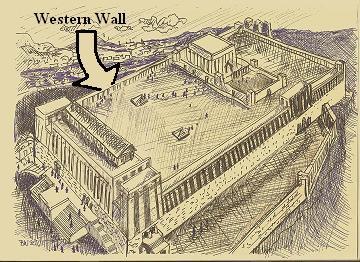
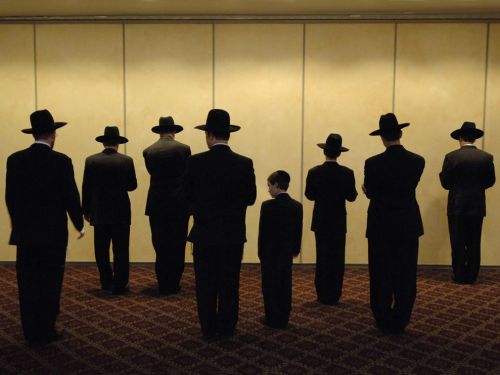
Of all the four walls of the Temple Mount, the Western Wall was the closest to the Holy of Holies, and therefore, the Jews believe that to pray by the Western Wall is particularly beneficial.  Many have determined that the area in front of the Western Wall has the status of a synagogue and must be treated with due respect.  As such, men and married women are expected to cover their heads and be dressed appropriately upon approaching the Wall.  They are also separated by a divider - men get the left half and women get the right half for praying.  When leaving, the Jewish custom is to walk backwards, always facing the wall.
There is a practice by many of placing written prayers that have been carefully folded into the cracks and crevices of the wall.  More than a million notes are placed here each year!

A practice that has been carried out by Jews since Solomon's time is praying toward the city of Jerusalem, specifically toward the Temple Mount.  Daniel did this when he prayed "...his windows being open in his chamber toward Jerusalem, he kneeled upon his knees three times a day, and prayed, and gave thanks before his God..."  Daniel 6:10  This practice comes from Solomon's dedication prayer of the temple in II Chronicles 6:38, "and pray toward their land, which thou gavest unto their fathers, and toward the city which thou hast chosen, and toward the house which I have built for thy name:"  It is common for us to see Jews praying just about anywhere, but always facing the direction of Jerusalem and the Temple Mount.

In my distress I called upon the Lord, and cried unto my God: he heard my voice out of his temple, and my cry came before him, even into his ears. Psalm 18:6

And there I will meet with thee, and I will commune with thee from above the mercy seat.  Exodus 25:22

However, now that we are His temple, we can come boldly to His throne at any place, at any time.  What a comforting thought that is for us and can be for you too!

Tuesday, April 10, 2012

Grocery store during Passover


Well, I'm not doing too well with my goal of blogging more often.  My kids finished school, the weather is perfect, and there is a great park just a few blocks from our apartment.  After being house-bound all winter, what more can I say? 

Brianna, Micah, and I walked to the grocery store and it was a good thing I had my camera with me!  With this week being Passover, all flour products are prohibited... So, what do grocery stores in Israel do with their un-kosher foods, shelves, and aisles?  Well, this is your answer...


The only flour the Jews are allowed to have or eat during Passover week is Matzo (unleavened bread), which is made of flour and water and has been speedily and thoroughly blended and baked, to avoid any chance of leavening.

Walking down the aisles of a grocery store during Passover teaches you that a number of foods you don't think would come under Passover food guidelines really do.  Of course, there are the obvious flour products:  bread, cookies, crackers, pastas, etc...  However, some foods come in contact with flour during their production process and are also prohibited - foods such as: sodas, coffee, some kinds of alcohol and vinegar, corn syrup, etc.  Just think for a moment how many food products contain corn syrup!


Pretty cool little girl standing there, don't ya think?  I think we'll wait until next week to do some real grocery shopping.  Good thing I was warned before-hand that this is what I would find in the stores!

Tuesday, April 3, 2012

Write them upon the posts of thy house

One thing you can't help but noticing here in Israel is a command in Deuteronomy that the Jews take literally: to "write them (the Scriptures) upon the posts of thy house."  This command is carried out by nailing something called a "mezuzah" (see definition above) to doorposts everywhere... homes, hotel rooms, business entrances, in malls, restaurants, etc...

Some even interpret Jewish law to require a mezuzah on every doorway in the home apart from bathrooms and small closets.
Placed inside the case of the mezuzah is a small rolled-up parchment with verses from Deuteronomy on them.  This parchment has been prepared by a scribe who has undergone many years of meticulous training, and the verses are written in black indelible ink with a special quill pen.

It is common to see a Jew touch a mezuzah and then place those fingers on their lips when they walk through doorways.  This custom is a sign of respect and affection for God and His Word.  You see this almost every time they enter a building!

The commandment to affix a mezuzah is widely followed in the Jewish world, even by Jews who are not religiously observant.  While the important part is not the case itself, designing and producing mezuzah cases has been elevated to an art form over the ages.  Mezuzah cases are produced from a wide variety of materials (metal, wood, stone, ceramic, pewter, and clay).

Some dealers provide their buyers with a copy of the text, but for observing Jews this is not acceptable.  Tourists (who are not as concerned with authenticity) often go home with replicas.

Below are some different mezuzahs you might see in Israel.  Notice how very different {and beautifully intricate and ornate} they can be:


Mezuzahs come in every color and style imaginable!  I'm really liking that turquoise one above.  Isn't it so pretty and sparkly?

We have two doorways that lead into our home and both of them have mezuzahs.  Though we are not Jewish, we do try to write God's Word in our hearts through memorizing the Scriptures as a family.

Deuteronomy 6:4-9  Hear, O Israel: The LORD our God is one LORD: And thou shalt love the LORD thy God with all thine heart, and with all thy soul, and with all thy might.  And these words, which I command thee this day, shall be in thine heart: And thou shalt teach them diligently unto thy children, and shalt talk of them when thou sittest in thine house, and when thou walkest by the way, and when thou liest down, and when thou risest up.  And thou shalt bind them for a sign upon thine hand, and they shall be as frontlets between thine eyes.  And thou shalt write them upon the posts of thy house, and on thy gates.